

Find Bodybuilding Competition Near Me: 2026 Guide

Table of Contents
How to Find a Bodybuilding Competition Near Me
Upcoming Bodybuilding Competitions: What the 2026 Schedule Looks Like
Where to Search for Verified Event Listings
Filtering by Distance, Date, and Sanctioning Body
Bodybuilding Competition Divisions: Matching Your Physique to the Right Class
Age Brackets From Youth to Grand Masters
Bodybuilding Competition Registration: A Step-by-Step Walkthrough
First Bodybuilding Competition Checklist
How to Choose a Federation Before You Register
What Competing Actually Costs Beyond the Entry Fee
Conclusion
Frequently Asked Questions
Last Updated: October 21, 2026
How to Find a Bodybuilding Competition Near Me
You want to step on stage, and the first real question is simple: where do I find a bodybuilding competition near me that I can actually enter? The answer starts with the federation calendar, not a general web search. Pick the sanctioning body first, then filter its event schedule by state and date. That single change saves you hours of dead ends.
At WPF USA, we field this question constantly from first-timers and Masters athletes alike. Here is the honest version of the process.
A bodybuilding competition is a sanctioned event where athletes present their physique in defined divisions and are scored by a panel of judges. The federation running the show sets the divisions, the drug-testing rules, and the registration deadlines.
Most people search backwards. They look for a show, then discover it belongs to a federation whose divisions do not fit them. Do it the other way around and everything gets easier.
Below, we walk through the full 2026 schedule landscape, how to filter events by distance, and how to match your physique to the right class.
Upcoming Bodybuilding Competitions: What the 2026 Schedule Looks Like
Upcoming bodybuilding competitions cluster into seasons in most regions, and knowing that rhythm tells you when to start prep. Federations typically publish their annual schedule in waves. Local and regional events usually land on the calendar later than national shows.
The practical move is to check the schedule quarterly, not once. New events get added as promoters confirm venues.
Where to Search for Verified Event Listings
Verified listings live in three places, in this order of reliability:
The federation's own event calendar. This is the source of truth for dates, venue, and divisions.
Official social channels of the federation and the promoter. Useful for last-minute changes.
State-level bodybuilding newsletters and forums. Good for gossip, unreliable for facts.
Cross-check any date you find against the federation site before you pay a registration fee. Event announcements get copied and reposted with old dates all the time.
Filtering by Distance, Date, and Sanctioning Body
Filtering is where most searches fall apart. A show two hours away in a different federation may still be the better fit than one twenty minutes away. Use this order:
Sanctioning body. Does the federation offer your division and age bracket?
Date. Is there enough runway for a full prep?
Distance. Can you travel, and does the show fit your budget?
Pro Tip Search by state first, then widen the radius. A regional event is often worth a longer drive than a nearby show that has no division for your age or class.
Bodybuilding Competition Divisions: Matching Your Physique to the Right Class
Bodybuilding competition divisions are the categories you enter, and choosing the wrong one is the most common beginner mistake. Each division rewards a different look. Bodybuilding rewards overall mass and symmetry. Classic physique rewards proportion and posing. Physique and fit model reward a leaner, more aesthetic frame. Bikini and figure have their own judging standards.
Match the division to your natural build, not your fantasy build. If you are tall and lean, forcing yourself into a mass class works against you.
Age Brackets From Youth to Grand Masters
Age categories run from youth divisions through Open, Masters, and Grand Masters brackets. WPF USA, for example, offers competition categories for all ages, from pre-teens through Grand Masters 65 and over. That matters if you are a Masters athlete who has lifted for decades and wants a fair field.
Parents should ask about youth divisions and scholarship opportunities directly with the federation. Ask how many scholarships are awarded and what the selection criteria are.
Bodybuilding Competition Registration: A Step-by-Step Walkthrough
Registration is predictable once you know the order, but the deadlines and eligibility checks trip up more first-timers than the form itself. Here is the full sequence, including the timeline most beginners miss.
Step 1: Confirm the event and division on the federation calendar. Start with the federation's own event calendar, not a general web search. Filter by state and date, then open the specific event page to confirm the divisions offered and the age brackets.
Step 2: Check membership requirements and timing. Most federations require an active athlete membership before you can register for a show.
Step 3: Read the eligibility rules for your division. This includes age brackets (youth through Grand Masters), any height or weight classes, and the drug-testing policy. If natural competition matters to you, ask for the testing policy in writing rather than accepting a verbal assurance.
Step 4: Note the registration deadline and prep timeline. Registration deadlines commonly fall two to four weeks before show day, and some promoters charge a late fee after the early-bird date.
Step 5: Complete the athlete registration form and pay the entry fee. Enter the correct division and age bracket. If you are entering more than one division, confirm whether a second-division discount applies. Keep the receipt.
Step 6: Book travel and lodging once your entry is confirmed. Do not book nonrefundable travel before you have a confirmation email. Venues and host hotels sometimes publish a room block; ask the promoter whether one exists.
Step 7: Submit music or posing details by the promoter's deadline. Many federations require a music file in a specific format and length. Submit early and bring a backup on a second device.
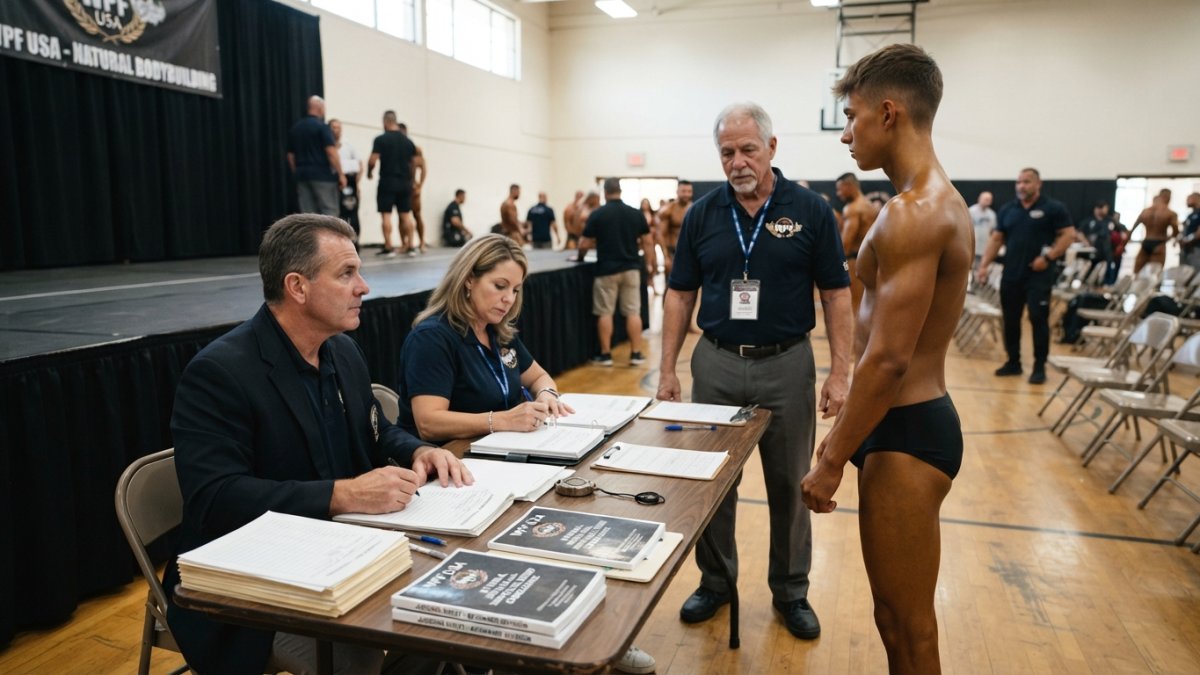
Step 8: Confirm check-in time and show-day logistics. Check-in is often the evening before or early the morning of the show. Confirm the time, location, and what to bring (membership card, ID, registration confirmation).
Keep copies of every confirmation. Promoters get busy, and your receipt and confirmation email are your proof if a division entry is questioned.
Watch Out Do not wait until the week of the show to join the federation or register. Membership processing, late fees, and sold-out divisions are the three most common reasons a first-timer misses a show they had planned to enter.
First Bodybuilding Competition Checklist
A first bodybuilding competition checklist keeps the last two weeks from turning into chaos. Pack and plan early, then rehearse.

Membership card and registration confirmation printed
Posing trunks and backup pair
Tanning products and applicator
Posing oil and a towel
Stage shoes
Music file on two devices, plus a backup
Snacks and hydration for a long show day
Pump-up bands and light weights
A friend or coach to handle backstage logistics
Cash for parking and incidentals
Watch Out Do not leave your music file on a single phone. Battery dies, cables fail, and a missing track can cost you your posing routine.
How to Choose a Federation Before You Register
Choosing a federation is the decision that shapes everything else, and most beginners rush it. Ask four questions before you commit.
Does it offer your division and age bracket? A federation without a Grand Masters class is useless to a 67-year-old competitor.
Is it drug-tested, and how is that enforced? If natural competition matters to you, ask for the testing policy in writing. Do not accept a verbal assurance.
What is the pathway upward? A clear route from local shows to international competition tells you the federation takes athlete development seriously. WPF USA, as an affiliate of the W.P.F. international, offers that pathway along with cash prizes at qualifying events.
Is it legitimate? Check that results are published, that the federation has a named leadership team, and that other athletes can point to their experience.
Key Takeaway Pick the federation that fits your age, division, and competitive goals. The show itself is the easy part.
What Competing Actually Costs Beyond the Entry Fee
The entry fee is the smallest line on the receipt, and most first-timers underestimate the total by a wide margin. A realistic budget for a local show usually lands in the low four figures once everything is counted.
Federation membership. Most federations require an annual athlete membership before you can register. Expect roughly $50-$150 per year depending on the federation and membership tier. This is separate from your entry fee and usually renews annually.
Entry fees. Local and regional shows commonly charge $75-$150 per division entered. Entering two divisions (for example, Open and Masters) often means paying twice, though some promoters offer a discounted second-division rate.
Coaching and prep programming. This is the largest and most variable cost. Online prep coaching for a 12-16 week contest prep commonly runs $150-$400 per month, and in-person coaching runs higher.
Posing coaching. Group posing classes are often $20-$50 per session; private posing coaching can run $75-$150 per hour. Budget at least a handful of sessions if you have never posed on stage.
Tanning. Competition spray tanning typically costs $100-$200 for a show, and many athletes book a touch-up coat for finals. Do not substitute a general salon tan, stage lighting washes out anything less than a competition-grade application.
Suit and stage shoes. Posing trunks run $40-$100; a competition bikini or figure suit can run $150-$500 or more depending on customization. Stage shoes add another $50-$150.
Travel, lodging, and meals. If the show is a drive away, budget fuel and parking. If you stay overnight, add a hotel night and meals. A common pattern is $150-$400 for a regional show within driving distance, and more if you fly.
Photography and video. Show photography packages commonly run $75-$250. This is optional, but many first-timers regret not booking it.
Backstage and miscellaneous. Cash for parking, backup tanning supplies, snacks, and a backup posing suit add up to another $50-$100.
A practical way to build your budget is to total the fixed costs first (membership, entry fee, tanning, suit) and then decide how much you can afford for coaching and travel.
Pro Tip Create a simple spreadsheet with one column per cost category and a running total. Update it as you confirm each price with the promoter. Athletes who budget line by line are far less likely to be surprised in the final two weeks.
Conclusion
Finding a show is easy once you stop searching and start filtering. Pick your federation, confirm your division and age bracket, then work backward to a date that gives you a real prep window.
WPF USA was built for exactly this: competition categories for every age from youth to Grand Masters 65 and over, youth scholarships, cash prizes, and a pathway to international competition through our W.P.F. affiliation. If you are ready to compete, start with our event calendar and athlete registration, and let us help you find your first stage.
Frequently Asked Questions
How do I find bodybuilding competitions near me?
Start with the schedule page of a federation that sanctions shows in your state, then filter by date and distance. WPF USA publishes its event calendar and regional listings, which lets you sort by city and state. Cross-check the venue address and the sanctioning body before you register. If you want a show within driving distance, search your metro area plus the next two states, since regional events often cluster within a few hours of each other.
How far in advance should I register for a bodybuilding competition?
Most federations open registration several months before the event date, and entry caps fill first in the popular divisions. Aim to register as soon as the show appears on the schedule, especially for novice and first-timer classes that tend to sell out. That timeline also gives you enough runway to plan a 12 to 16 week prep, book travel, and confirm your membership is active before the deadline.
Can beginners compete in bodybuilding competitions?
Yes. Most federations run novice and first-timer divisions built specifically for people who have never stepped on stage. WPF USA supports new competitors through age-based categories and beginner-friendly divisions, so you are not placed against seasoned open-class athletes. Pick a show with a true novice class, read the division rules carefully, and expect your first event to be about learning the posing and backstage routine rather than winning.
How much does it cost to compete in a bodybuilding show?
Costs vary by federation, division count, and travel distance. Budget for membership, entry fees per division, a posing suit, tanning, and travel or hotel if the venue is out of town. WPF USA does not publish fixed pricing, so check its website for current fees and ask about membership requirements before you commit. Adding a second division usually raises your entry cost, so decide how many classes you want before registering.
Subscribe

Comments